
Confusion around Amazon Gift Cards does not come from carelessness or lack of attention, and it usually grows from everyday use mixed with incomplete understanding. People buy gift cards, redeem them, and see balances appear across different screens, yet the system rarely explains itself in plain language. Over time, repeated assumptions replace clarity, and those assumptions start behaving like facts even when they are never confirmed.
This first part focuses on why that confusion lasts and which beliefs continue to circulate, not to correct anyone abruptly but to understand how these ideas form and why they feel reasonable from the inside. If you want a campaign-style companion piece, see our Free Amazon Gift Cards Giveaway guide.
Why Amazon Gift Card Confusion Persists
The persistence of confusion has more to do with the environment than with individual behavior.

Familiarity Without Full Context
Amazon Gift Cards appear simple on the surface because the action of redeeming a code feels quick and uneventful. That ease hides the complexity of how balance behaves inside an account, how checkout previews work, and how confirmation differs from display.
When people interact with a system daily without needing to understand its structure, assumptions quietly fill the gaps.
How Repetition Turns Assumptions Into Beliefs
A single confusing experience rarely creates a myth. Repetition does. Stories shared in comments, screenshots passed between friends, and partial explanations repeated online slowly harden into shared belief.
Over time, the belief feels safer than questioning the system again.
Common Amazon Gift Card Myths That Still Confuse Users
Each myth below exists because it feels logical within a limited view of the system.
Myth 1: Amazon Can Ask for Gift Card Codes to Fix Problems
This belief often forms because gift cards already sit inside the Amazon ecosystem, which makes it feel reasonable to imagine support using them for verification or correction. The familiarity of the platform blurs the boundary between payment and communication.
The logic feels internal, even though it does not match how support systems actually function. Amazon itself warns that you should never share Amazon Gift Card claim codes to pay third parties, which helps draw a clearer boundary between support communication and stored value.
Myth 2: Gift Card Balance Can Be Taken Automatically
Checkout previews display the balance application before confirmation, which creates the impression that the action has already happened. When the preview looks final, the mind treats it as final.
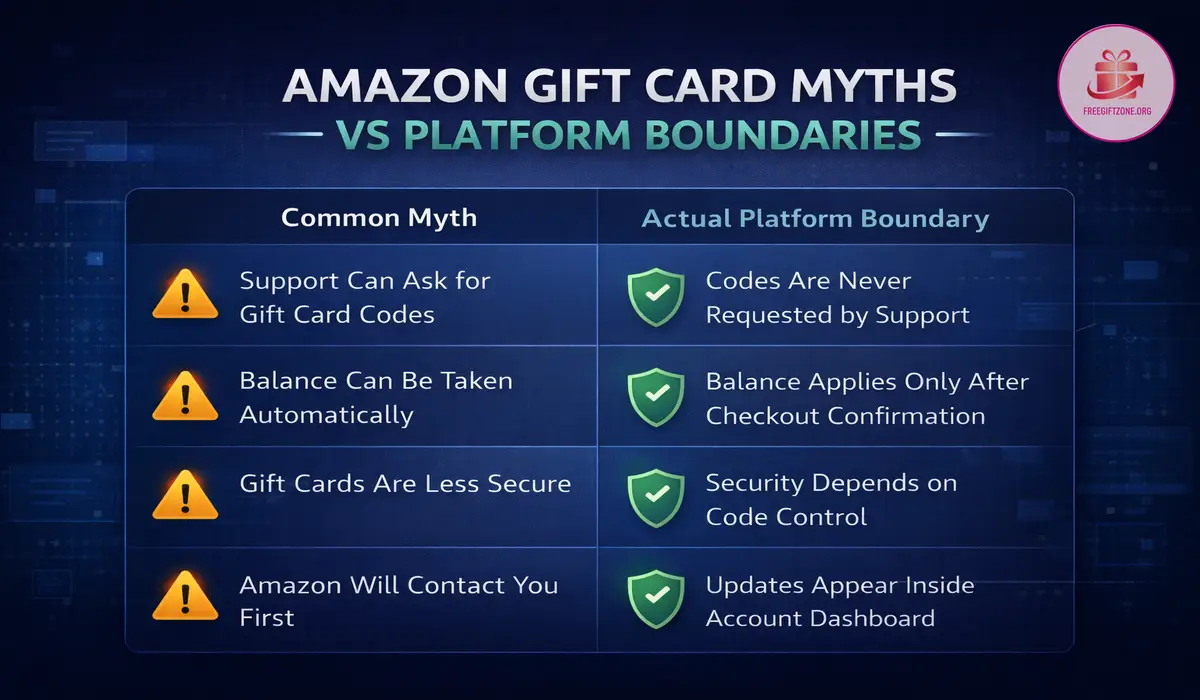
That visual shortcut explains why this belief continues, even among experienced users.
Myth 3: Gift Cards Are Less Secure Than Other Payment Methods
Gift cards feel informal compared to cards or bank transfers, which leads to the assumption that they carry less protection. The lack of visible security steps creates a perception of weakness.
In reality, the difference lies in reversibility, not in system care.
Myth 4: Gift Card Issues Always Mean User Error
When something goes wrong, you usually assume that you made a mistake because the platform does not clearly explain every boundary condition or exception inside its rules. That assumption slowly turns into a general belief that errors always come from user misuse, even when the structure of the system itself contains gaps or unclear conditions.
This belief persists because clarity rarely arrives after the fact.
Myth 5: Amazon Will Contact You First About Gift Card Problems
Some people assume that if there is an issue with a gift card balance or redemption attempt, Amazon will automatically reach out through email, text message, or phone call before any visible account change appears. That belief forms because many digital services send alerts for account activity, which creates an expectation that every irregularity triggers direct communication.
In practice, most account related updates appear directly inside your Amazon account dashboard, and unsolicited contact that asks for codes or urgent action does not match the way Amazon normally communicates with users through its official website or mobile application.
Myth 6: A Higher Value Gift Card Changes Support Priority
Another common belief suggests that larger denomination gift cards receive faster attention or special handling compared to smaller amounts, as if the value size changes how internal systems treat the request. This assumption forms because people associate a higher monetary value with a higher service urgency in other financial contexts.
Support systems, however, process gift card issues through standardized procedures that apply the same review structure regardless of denomination. The value amount does not alter the verification sequence or accelerate resolution simply because it is larger.
Why These Myths Feel Reasonable
These myths remain active because they usually contain a small part of observable truth, and that partial accuracy makes them appear believable even when the larger conclusion is incomplete or slightly distorted.
A payout delay may actually occur, a survey may actually disqualify you, or a redemption may actually take longer than expected, and those real events create a base that supports the myth even though the underlying cause is often more procedural than suspicious.
When a statement reflects one real experience but ignores the structural explanation behind it, the mind accepts the simplified version as accurate, and that is how partial truth slowly turns into a stable belief.
Visual Design Shapes Interpretation
Screens display balances, reward previews, and redemption options in the same view, and that layout naturally pushes you toward quick conclusions instead of a detailed understanding of how each element connects to the rules behind it.
The interface is built to let you act quickly rather than study the mechanics, so when information appears together without step-by-step clarification, the mind assigns meaning on its own before checking the underlying conditions.
You interpret first because that requires less effort than verifying every detail inside the system.
Silence Creates Its Own Narrative
When systems do not explain what they will never do, people imagine possibilities based on past experiences elsewhere. Silence invites speculation, and speculation spreads faster than clarification.
Why Clear Boundaries Matter More Than Warnings
Clarity works better than fear when confusion has settled in for years. Warnings tell people what to avoid, but boundaries explain how a system actually behaves and where it deliberately stops. Once those limits feel understood, doubt loses its grip because expectation aligns with reality instead of imagination.
This part focuses on those limits calmly, without urgency or alarm, because authority does not need volume to be effective. For the formal usage rules behind stored value and redemption, Amazon also publishes its Amazon Gift Card terms and conditions.
What Amazon Will Never Ask for Under Any Circumstance
Some actions remain completely outside how Amazon operates, regardless of situation, urgency, or account status, because those limits exist at the structural level rather than as adjustable conditions. These limits do not change based on context or timing. They exist as fixed boundaries within the system design.
If you want more Amazon gift card, please check these Best Legit Apps That Pay Amazon Gift Cards Instead of Cash that actually provide what you are looking for.
Gift Card Codes Will Never Be Requested by Support
Amazon Gift Card codes function as stored value, not as identity markers or verification tools. Once a code is shared, the value transfers immediately, which removes the possibility of review, reversal, or confirmation.
Because of that design, no legitimate support process can involve asking for a code by phone, email, chat, or message, since doing so would bypass every protection the system is built around.
Gift Cards Will Never Be Used to Resolve Account Problems
Account issues follow traceable workflows that rely on logged actions, verified identities, and visible resolution paths. Gift cards sit outside that system entirely, which makes them unsuitable for refunds, penalties, security fixes, or verification steps.
When a request suggests using gift cards to fix a problem, the request already stands outside how the platform operates.
Urgent Deadlines Will Never Be Attached to Gift Card Requests
Real support processes place verification before speed, even when a situation appears time sensitive, because internal review steps do not disappear simply due to urgency. While organizations may work within internal timelines, that pressure is not transferred to you through panic language, countdown threats, or demands for immediate payment through gift cards.
When urgency appears together with instructions involving gift cards, the structure resembles imitation behavior rather than normal operational procedure.
Why These Boundaries Exist Inside the System
These boundaries are not random or emotional decisions, because they are built into the structure of large platforms to protect users from loss and to protect the company from fraud or system abuse at the same time.
Traceability Protects Both Sides
Legitimate payments and corrections require records that can be audited, reviewed, and reversed when necessary. Gift cards remove those capabilities the moment a code is shared, which makes them incompatible with dispute resolution and consumer protection standards.
Systems avoid paths they cannot defend later.
Separation Between Support and Payment Prevents Abuse
Support channels exist to explain, correct, and verify, not to collect value. Mixing payment requests into support conversations breaks accountability and creates risk that no large platform accepts.
That separation is intentional and permanent.
How Scams Lean on Myths Instead of Breaking Rules
Any type of fraud attempt usually does not create a new story from the beginning, because most schemes enter areas where confusion or common myths already exist and then rely on those existing beliefs to make their message appear believable.
When Belief Replaces Verification
If someone already believes that support might ask for a gift card code, the scam does not need to convince them. The scam only needs to sound familiar enough to avoid triggering doubt.
Belief shortens the distance between request and compliance.
Authority Language Fills the Gap Left by Silence
Formal language and terms that imitate the wording used by large companies take the place of real verification when you do not clearly understand how the system actually works and where its limits exist. A message can appear accurate and professionally written, and that surface credibility makes the request appear possible even when the structure behind it does not support the claim.
How to Respond When a Request Feels Wrong
Your response matters more than your first reaction, because a quick emotional reply usually follows pressure, while a measured reply follows understanding of the situation. When you pause for a moment and review what is being asked, the urgency that seemed powerful a few seconds earlier starts to lose strength because the request no longer controls your pace.
A calm pause interrupts the pressure cycle, and once that cycle breaks, the demand for immediate action becomes weaker without the need for confrontation or argument.
Pausing Before Acting
When you pause before responding and step away from the message or call, the urgency that was pushing you toward quick action begins to weaken because pressure depends on speed to remain effective. A short delay gives you space to think through what is being asked instead of reacting to the tone of the request.
Real platforms tolerate delay because their systems remain stable regardless of how quickly you respond. Fraud attempts depend on momentum, and once that momentum slows, their leverage reduces significantly.
Verifying Through Independent Paths
When you check your account status directly through the official website or the official mobile application, you gather information without interacting further with the request that triggered concern. That separation is important because it prevents the sender from guiding your next step.
Independent verification restores control by replacing a story told inside a message with data shown inside your own account interface. If a request still seems suspicious, the FTC gift card scam guidance gives a useful checklist for what to avoid and how to report it.
Frequently Asked Questions
Can Amazon ever refund losses from gift card scams?
Refunds rarely occur because gift card value transfers instantly once a code is shared, but reporting still matters because it helps prevent repeat targeting and platform misuse.
Why do scammers focus so heavily on gift cards?
Gift cards move value quickly and leave little room for reversal, which suits methods that depend on speed and anonymity rather than negotiation.
Why does Amazon not explain these boundaries more loudly?
Platforms balance education with usability, and overloading users with warnings often reduces trust rather than increasing it. Clear boundaries work best when understood calmly, not memorized under stress.
Reflection on Confidence Through Understanding
Confidence grows when systems feel predictable instead of mysterious. Knowing what Amazon will never ask for removes entire categories of doubt and makes suspicious requests easier to recognize without panic.
Awareness does not demand constant vigilance. Awareness settles in quietly when expectations match reality, and once that match exists, confusion loses its power.