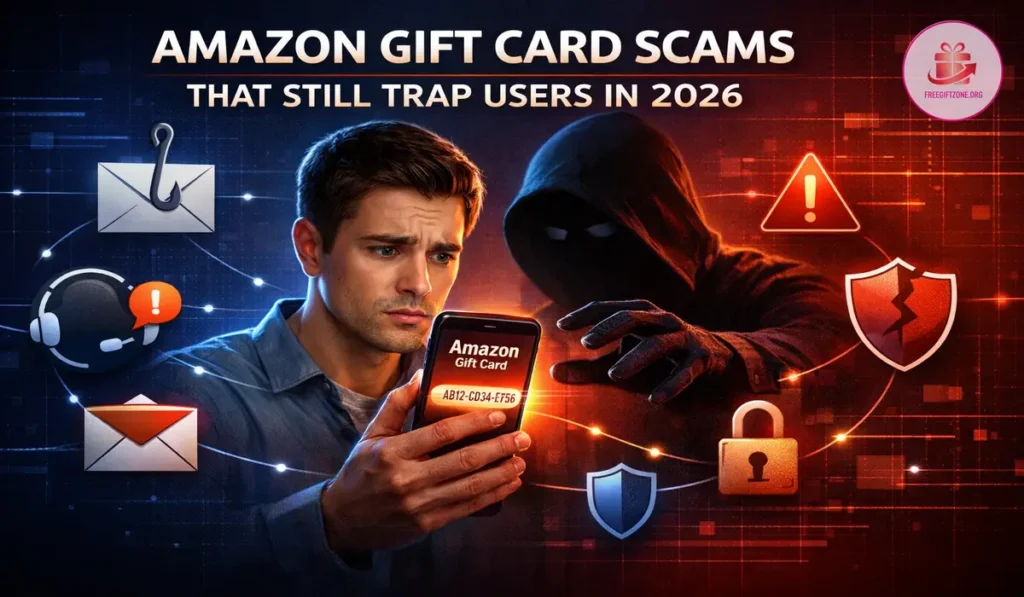
Amazon Gift Card scams continue to appear in 2026 because the structure behind them has not changed, even though the messaging, formatting, and delivery methods have evolved. Gift cards move value instantly; they do not require bank approval, and once the code is shared, the transfer cannot be reversed in most situations. That combination keeps them attractive to fraud networks even as public awareness increases.
Scams today do not rely on obvious spelling mistakes or poorly designed pages. They rely on timing, context, and emotional leverage. This article explains why Amazon Gift Cards remain targeted, what formats are still active in 2026, how those scams are structured, and how to detect them before damage occurs. Amazon’s own scam trends guidance is useful here because it shows how modern fraud messages increasingly imitate normal communication.
Why Amazon Gift Cards Remain a Target in 2026
Gift cards function as prepaid digital value, and that value behaves similarly to cash once redeemed or shared. This characteristic alone makes them attractive to anyone attempting fast, untraceable transfers.
Instant value transfer without reversal
When a gift card code is revealed and redeemed into another account, the value moves immediately. There is no waiting period and no dispute window similar to credit card chargebacks. That immediacy reduces recovery options and increases scam efficiency.
Easy resale and liquidation
After redemption, value can be converted into products, resold goods, or secondary marketplace credits. Resale markets allow scammers to convert digital value into other forms quickly, which reduces traceability and prolongs scam viability.
Familiarity lowers resistance
Amazon Gift Cards are common for birthdays, promotions, and online rewards. Because the product itself is ordinary, requests involving gift cards do not immediately trigger suspicion in the way unusual payment requests might.
| Characteristic | Why It Attracts Scammers |
|---|---|
| Instant redemption | No reversal window |
| Widely accepted | Easy to convert to goods |
| High trust brand | Low initial suspicion |
| Digital code format | Simple remote transfer |
What Has Changed in 2026
Scam delivery methods have adapted to new technology while maintaining the same underlying structure.
AI-generated scam communication
Fraud messages now use grammatically correct language, realistic formatting, and contextual references that match recent purchases or account activity. Automated tools generate personalized messages at scale, which reduces obvious red flags.
Voice cloning and impersonation calls
Voice cloning tools allow scammers to imitate employers, colleagues, or family members during urgent calls. The request often involves purchasing Amazon Gift Cards and sharing codes under the claim of emergency reimbursement.
Search engine placement and sponsored ads
Scam pages now appear in search results or paid advertisement slots next to legitimate pages. Visual similarity and strategic keyword usage increase accidental clicks.
The Most Common Amazon Gift Card Scams Still Active
Although formats evolve, several core scam categories continue to trap users.
Impersonation of Amazon support
Callers or emails claim suspicious account activity and instruct victims to purchase gift cards to restore access. Real Amazon support does not request gift card payment for account recovery. Amazon also warns that you should never share claim codes to pay third parties, which is one of the clearest boundaries for spotting a fake request.
Government or tax authority impersonation
Fraudsters impersonate tax agencies or law enforcement and demand immediate gift card payment to avoid penalties. Official agencies do not collect payments through gift cards.
Workplace executive email scams
Employees receive urgent messages appearing to come from a manager or executive requesting gift cards for client gifts or internal rewards. The email address often resembles the real company domain but contains subtle differences.
Fake giveaways and generator pages
Websites promise free Amazon Gift Cards after survey completion or code generation steps. These pages simulate validation screens and progress bars but do not connect to Amazon systems.
Romance and emergency manipulation
Scammers build emotional trust over time and then request gift card assistance for travel, medical bills, or temporary hardship. Emotional context replaces logical verification.
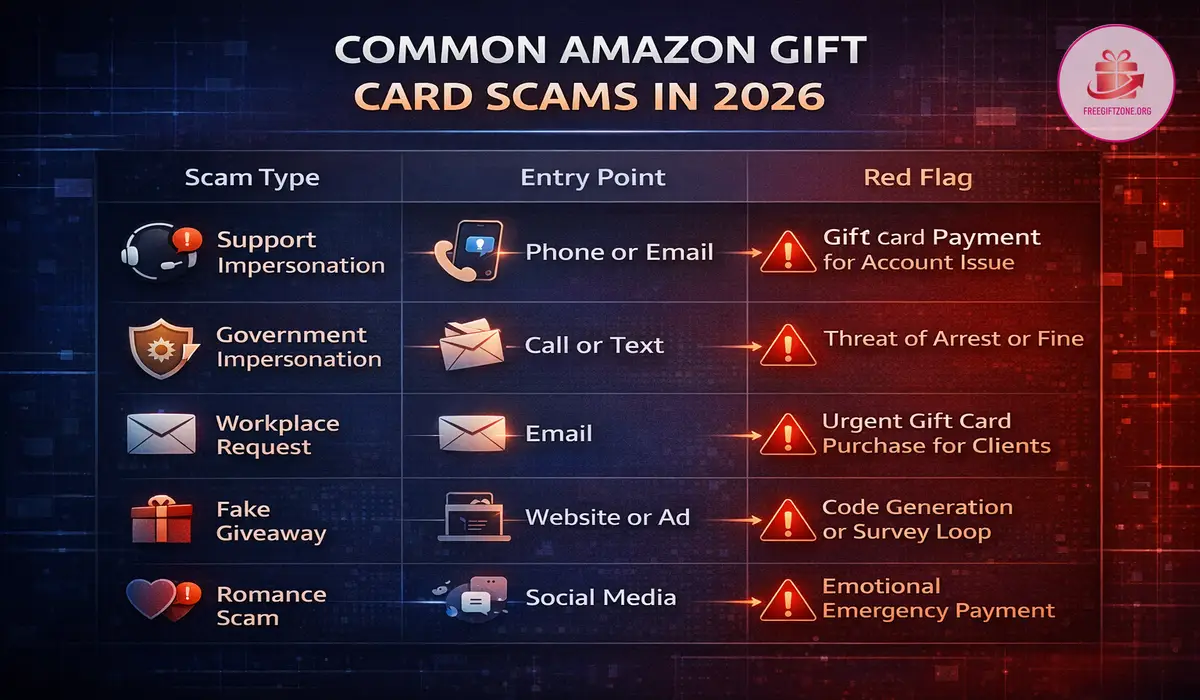
| Scam Type | Entry Point | Red Flag Behavior | Why It Works |
|---|---|---|---|
| Support impersonation | Phone or email | Payment request for account issue | Authority pressure |
| Government impersonation | Call or text | Threat of arrest or fine | Fear response |
| Workplace request | Urgent purchase instruction | Trust in hierarchy | |
| Fake giveaway | Website or ad | Code request or survey loop | Reward expectation |
| Romance scam | Social media | Emotional emergency request | Emotional attachment |
The Structural Pattern Behind Most Gift Card Scams
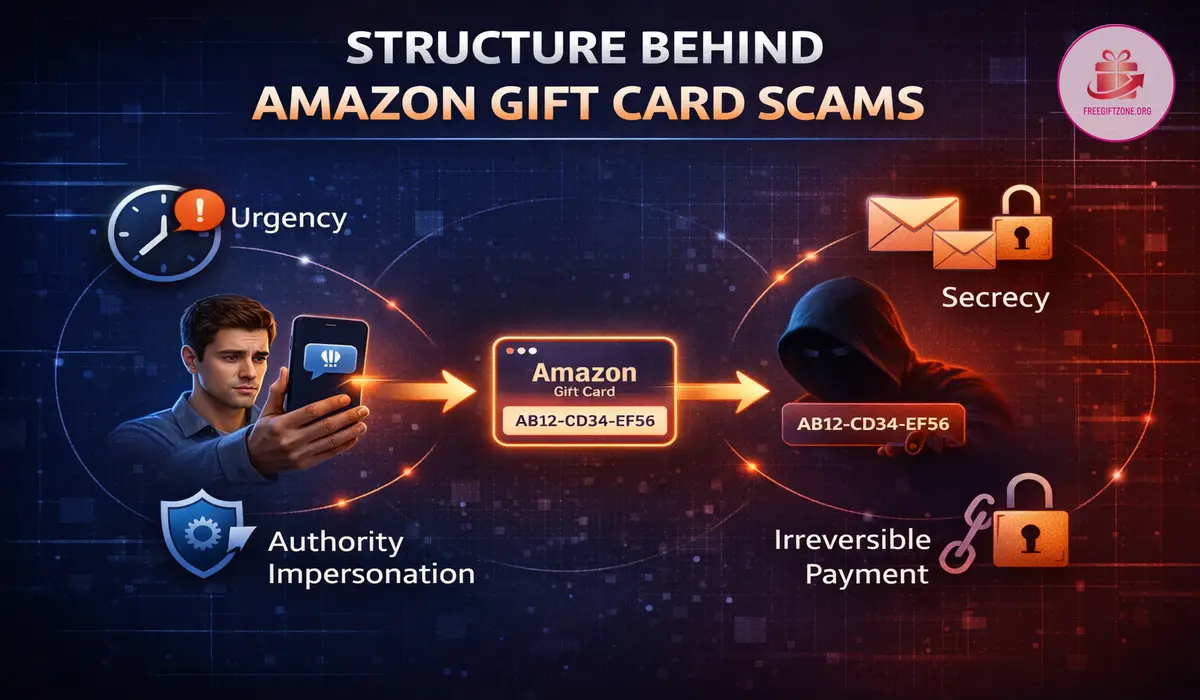
Despite surface differences, most Amazon Gift Card scams rely on four structural elements.
- Urgency that reduces decision time
- Authority that discourages questioning
- Secrecy that isolates the victim
- Irreversibility of the payment method
Urgency shortens reflection time. Authority increases compliance. Secrecy prevents outside verification. Irreversibility ensures financial loss once the code is shared.
Why Even Careful Users Still Fall for Them
Knowledge alone does not eliminate vulnerability because scams target context rather than ignorance.
Pressure changes decision speed. Emotional framing changes perception. Small initial compliance, such as replying to a message or clicking a link, increases the likelihood of larger compliance later.
How to Detect and Stop Amazon Gift Card Scams Early
Early detection depends on structural awareness rather than memorizing specific phrases.
Immediate warning signs
- Request to scratch and read the code aloud
- Instructions to keep the transaction confidential
- Paymentis required to fix an unrelated problem
- Countdown timers or expiring threats
What Amazon will never do
- Ask for gift card codes for verification
- Demand gift card payment to unlock accounts
- Threaten arrest or penalties through customer service
- Request communication outside official channels
If any request violates these boundaries, the scenario does not align with legitimate Amazon operations.
What To Do If You Shared a Gift Card Code
Immediate action increases the possibility of limiting damage.
Contact Amazon customer support through the official website and report the incident. Provide the gift card number, redemption status, and any communication details. If the code has not yet been redeemed, quick reporting may prevent use.
Report the incident to the Federal Trade Commission through reportfraud.ftc.gov in the United States. Victims may also file a complaint with the FBI Internet Crime Complaint Center at ic3.gov. Reporting contributes to pattern tracking and public warnings.
Conclusion
Amazon Gift Card scams persist because the payment method remains fast, trusted, and irreversible once transferred. While technology changes the presentation, the structural elements remain consistent across formats. Understanding those elements provides stronger protection than relying on surface level warnings.
Verification should always precede action. Any demand for gift card payment tied to urgency, authority, or secrecy conflicts with legitimate platform behavior. Awareness combined with structural clarity reduces risk and limits exposure to evolving scam tactics.
Frequently Asked Questions
Can Amazon refund losses from gift card scams?
Refunds rarely happen because the value transfers immediately after code sharing. Reporting still matters because it helps prevent further abuse.
Why do scammers insist on gift cards instead of other forms of payment?
Gift cards move value fast and leave little trace. That combination suits scams that rely on speed and anonymity.
Are these scams increasing or only changing?
The structure stays consistent while language and platforms shift. Awareness must evolve with those changes.