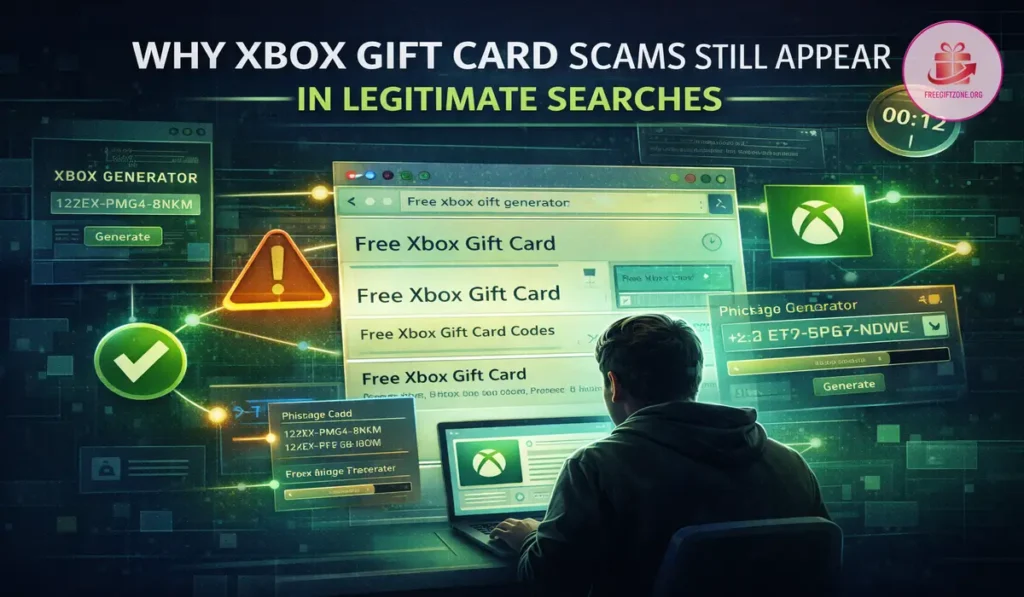
When you search for Xbox Gift Card giveaways, sweepstakes, or digital reward pages, you are already entering a space where digital delivery, limited availability, and online participation are normal expectations, and that shared expectation is exactly where scam pages position themselves. They do not invent new behavior patterns. They step into existing demand and remove the safeguards that legitimate platforms use.
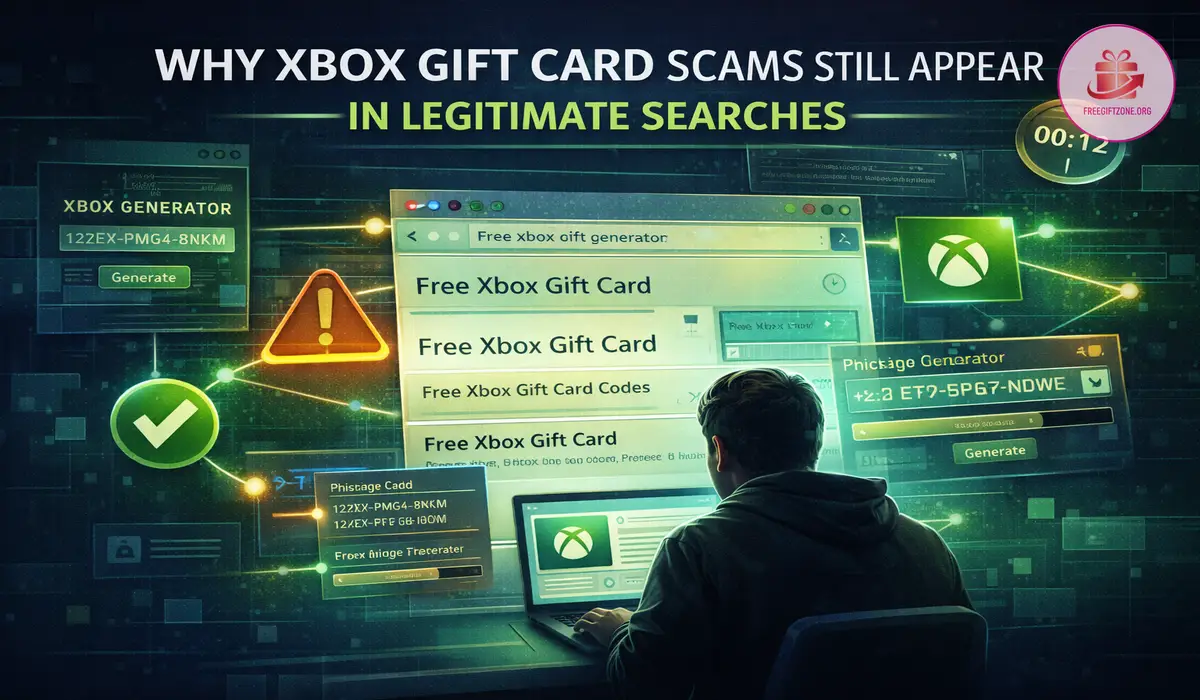
The overlap between real promotions and imitation pages explains why scam results can appear even when you believe you are searching carefully and filtering out obvious red flags. The surface format looks familiar because the reward type is familiar, and that familiarity lowers your guard before structure is evaluated. Microsoft’s guidance on Microsoft and Xbox gift cards is a useful reference point because legitimate gift card use follows a very different path from giveaway-style scam pages.
Why Awareness Alone Has Not Eliminated Xbox Gift Card Scams
Warnings about digital scams exist across blogs, gaming forums, and official help pages, yet scam pages continue to circulate because awareness alone does not change how search demand functions or how online promotion systems surface content.
Familiar rewards lower skepticism
An Xbox Gift Card is part of normal gaming activity, used for subscriptions, downloadable content, and digital purchases, which means the reward itself does not trigger immediate suspicion. When the prize fits everyday gaming behavior, the offer appears realistic even if the source remains unclear.
You trust what already matches your routine.
Giveaway language creates legitimate cover
Real campaigns use phrases such as limited availability, digital code delivery, and online redemption because those descriptions accurately reflect how digital promotions operate. Scam pages reuse the same vocabulary because the wording itself is not exclusive and can be copied easily.
When imitation mirrors normal promotional language, surface level filtering becomes unreliable.
Awareness does not fail because users ignore warnings. It fails because imitation blends into patterns that already exist.
How Fake Xbox Gift Card Giveaways Are Structured
Fake campaigns may differ in wording and visual style, yet the structural weaknesses remain consistent across most versions once you look beyond the surface design.
Key structural gaps found in fake campaigns
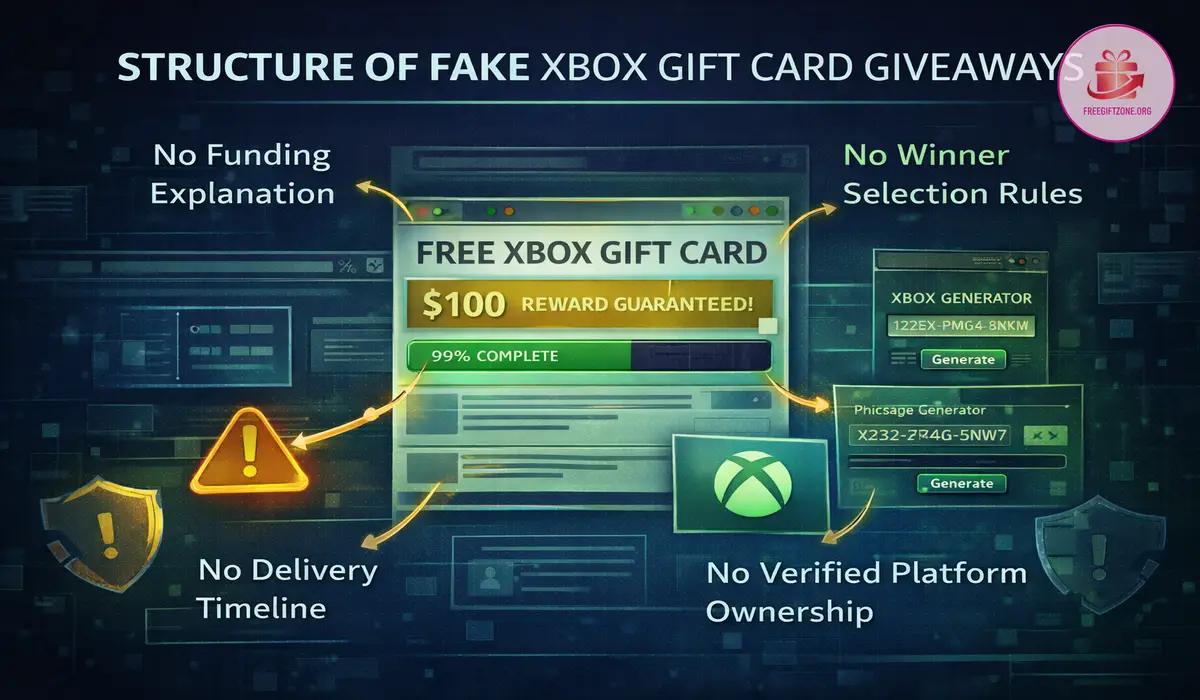
When you examine the page carefully, you will usually notice missing or vague elements that real platforms define clearly.
- No explanation of how the rewards are funded
- No clear method describing how winners are selected
- No defined delivery timeline beyond broad promises
- No verifiable ownership details or platform history
These gaps matter more than logos, color themes, or page animations because structure determines legitimacy, not decoration.
Comparison Between Real and Fake Xbox Gift Card Giveaways
A structural comparison reveals differences that you can verify quickly without relying on visual judgment alone. For comparison, Microsoft documents the normal path for adding money to a Microsoft account, which makes the difference between a real value flow and a fake promise much easier to spot.
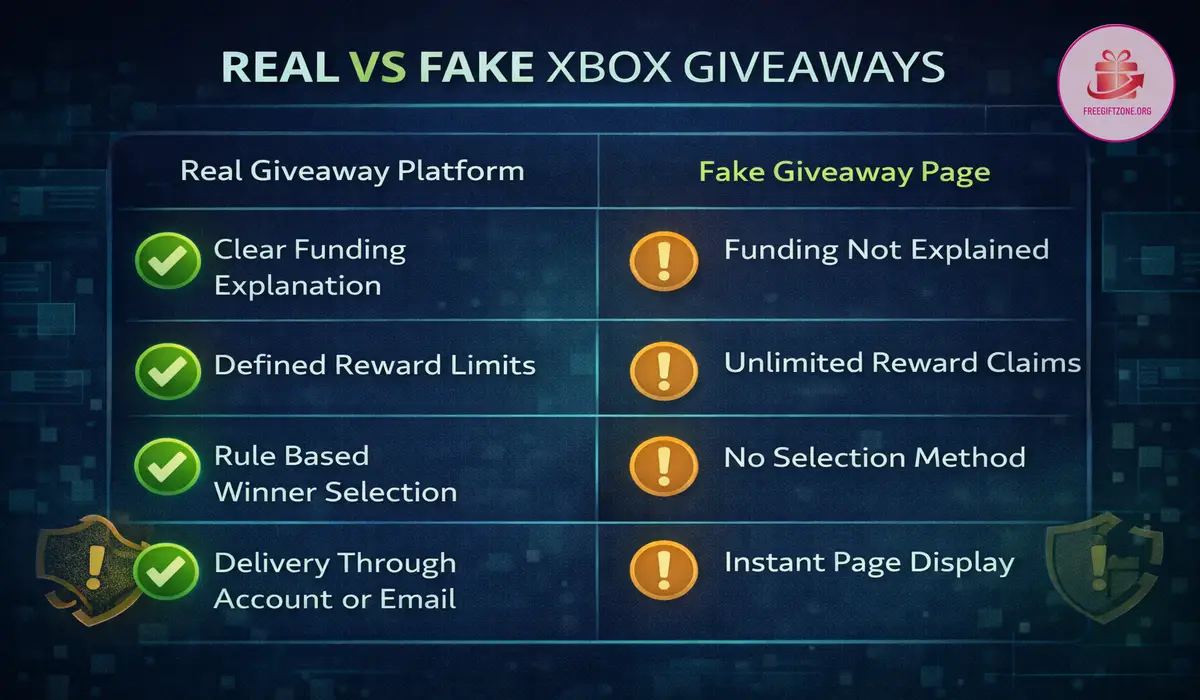
| Aspect | Real giveaway platforms | Fake giveaway pages |
|---|---|---|
| Funding explanation | Clearly stated with limits or budgets | Not explained or avoided |
| Reward limits | Defined caps or fixed quantities | Unlimited or exaggerated claims |
| Winner selection | Rule based process or random draw | Not described clearly |
| Delivery method | Account dashboard notification or registered email | Instant page display or unclear method |
| Payment requirement | No payment required to participate | Payment framed as verification or processing |
Structural clarity always outweighs reward size.
Common Xbox Gift Card Scam Formats Seen Today
Scam formats repeat because they are inexpensive to deploy and easy to duplicate, which allows them to reappear quickly even after removal.
Fake Xbox Gift Card code generators
Generator pages simulate activity through progress bars, loading animations, and staged validation screens that suggest technical access to Microsoft systems. In reality, Xbox Gift Card codes cannot be created externally because validation and issuance occur inside Microsoft owned servers and internal validation systems that sit behind the official redemption flow.
Interactivity creates illusion, not access.
Instant code and guaranteed reward pages
Some pages remove any element of probability and promise guaranteed rewards to every visitor, which eliminates selection logic entirely. Real giveaway platforms cannot guarantee outcomes because distribution depends on defined rules and limited supply.
Certainty replaces accountability in these structures.
Impersonation through branding and layout
Impersonation campaigns copy visual elements to create familiarity and reduce skepticism.
- Platform names or logos
- Color schemes and layout patterns
- Promotional wording from real campaigns
Domains may include extra words or subtle spelling variations that are easy to overlook at first glance. Visual similarity replaces verification when the structure is not examined.
Pay to unlock or verification fee traps
Any request for payment before reward delivery contradicts the giveaway model itself, even when the fee is described as unlocking access, processing, or identity confirmation. A reward system cannot require payment to release a prize without changing the nature of the transaction.
Rewards do not require payment to be legitimate.
How Scam Pages Simulate Authority
Scam pages rarely claim direct control over Microsoft systems, yet they imitate the tone and structure of official communication in order to create credibility without having actual access.
Support and security framing
Messages frequently reference account reviews, verification checks, or temporary security holds in order to resemble real support language. The wording may appear structured and professional, yet there is no connection to your actual account data inside the official Xbox or Microsoft environment.
When access is real, it appears inside your account dashboard, not inside an unrelated page.
Artificial urgency as a control tool
Countdown timers, limited hour warnings, or expiring claim notices are used to reduce the time you spend evaluating the page. Speed replaces verification in these designs. Real platforms allow time for review because legitimate offers do not collapse within minutes of exposure.
Urgency exists to restrict thinking, not to improve service.
What Real Xbox Gift Card Giveaway Platforms Never Do
Understanding boundaries prevents confusion better than memorizing scattered warnings because legitimate platforms operate inside fixed operational limits that do not change based on circumstance.
The following actions do not occur inside legitimate reward systems.
- No request for payment to enter or claim a giveaway
- No request to share Xbox Gift Card codes you already own
- No shift of communication to private direct messages or unrelated pages
- No guarantee that every participant receives a reward
Each of these actions breaks accountability and cannot exist inside a structured digital reward system.
Why These Boundaries Exist
These limits are not marketing decisions. They exist because of how digital reward systems are engineered and monitored at scale.
Traceability and accountability
Legitimate platforms rely on logged entries, trackable submissions, and auditable reward distribution processes that can be reviewed later if disputes arise. Once a gift card code is shared, it behaves like cash and cannot be reversed easily, which makes it unsuitable for account verification steps or customer service resolution processes.
Systems avoid processes that cannot be audited afterward.
Separation between support and rewards
Support channels exist to explain rules and resolve account issues. Reward systems exist to distribute promotional value. Mixing value collection with support communication creates risk that no structured platform accepts.
That separation remains fixed regardless of the situation.
How to Quickly Evaluate an Xbox Gift Card Giveaway Before Participating
Evaluation works best when you focus on structure rather than reward size, because structure reveals intent more reliably than visual design.
Platform transparency signals
Legitimate platforms typically display foundational information openly.
- Clearly written rules and eligibility requirements
- Visible history of past campaigns or announcements
- Contact or support information connected to the main website
- Consistent branding that matches the official domain
Transparency may appear ordinary, yet ordinary structure signals operational stability.
Technical and content signals
Page behavior and content depth provide additional clarity.
- Stable domain without unexpected redirects
- Secure connection and consistent page loading behavior
- Detailed explanation of the process rather than only reward claims
- Content that extends beyond a single promotional paragraph
Thin content usually indicates weak structure.
Behavioral signals
Tone and interaction patterns reveal intent even when the design appears polished.
| Behavior pattern | Likely meaning |
| Heavy urgency and countdown timers | Pressure replacing verification |
| Guaranteed rewards for everyone | No real selection process |
| Requests for secrecy | Avoidance of scrutiny |
| Payment required before delivery | Invalid giveaway model |
Behavior tells the story even when visuals appear professional.
What to Do If You Encounter a Suspected Scam
Your response determines risk exposure more than the initial message itself.
Avoid engagement
Interacting with suspicious pages increases targeting and potential data exposure. Closing the page prevents escalation without confrontation. Silence reduces exposure.
Verify independently
Checking the official Xbox or Microsoft website directly through your own browser restores clarity without relying on links provided by the suspicious page. Independent verification separates narrative from actual account data.
Report when possible
Reporting suspicious domains or pages through browser tools or platform reporting channels helps reduce visibility and limits the campaign lifespan. Reporting focuses on prevention rather than recovery in cases that involve gift card misuse or deception.
Why Fake Xbox Gift Card Giveaways Disappear Quickly
Scam campaigns operate on short life cycles because continuity is not part of their model.
- Domains are disposable and inexpensive to replace
- No long-term relationship with users is required
- Reputation loss has little impact once traffic is captured
- New variations can be launched with minor design changes
Real platforms invest in continuity because sustainable operations depend on user trust and participation that continues over extended periods of time.
Frequently Asked Questions
Are all free Xbox Gift Card giveaways scams?
No, free Xbox Gift Card giveaways can be legitimate when they are backed by real platforms, clear rules, and transparent funding. The key difference lies in structure and accountability, not in the promise itself. Evaluating how a giveaway operates matters more than judging the reward.
Why do scam giveaway pages sometimes rank on search engines?
Scam pages often exploit short-term SEO tactics and trending keywords to gain temporary visibility. Search engines remove many of these pages over time, but new ones appear quickly. Ranking position should never be treated as proof of legitimacy.
Can losses from Xbox Gift Card scams be recovered?
Recovery is difficult because gift card value transfers instantly once a code is redeemed. Reporting still matters because it helps limit further abuse and improves detection patterns. Prevention remains more effective than recovery in these cases.
Why do scammers prefer gift cards over other payment methods?
Gift cards move value quickly and lack reversal mechanisms, which suits short-term exploitation. The speed benefits scammers, not users. Legitimate platforms avoid this risk by separating rewards from verification or payments.
Closing Perspective
Xbox Gift Card giveaway scams succeed through imitation rather than persuasion. They borrow the surface language of real platforms while removing the structure that makes giveaways legitimate. Understanding what real platforms never do creates a clear boundary that emotion and urgency cannot cross.